Bringing V2X Connectivity to Micromobility
Improvements in vehicle sensing have significantly increased road safety. Cameras, radar and lidar can detect many hazards with high accuracy when there is a clear line of sight. The difficulty comes when visibility is restricted.
At junctions, crossings and urban intersections, a cyclist may be hidden by buildings, parked vehicles or other road users until they enter the same space as a vehicle. At that point, the time available to react may be limited.
This problem is becoming more important as cities accommodate a wider mix of transport modes. Bicycles, e-bikes and scooters now share road space with cars, buses and delivery vehicles. To improve safety in these environments, vulnerable road users need to be visible to the wider transport system before they are physically seen.
Communication can extend awareness beyond line of sight
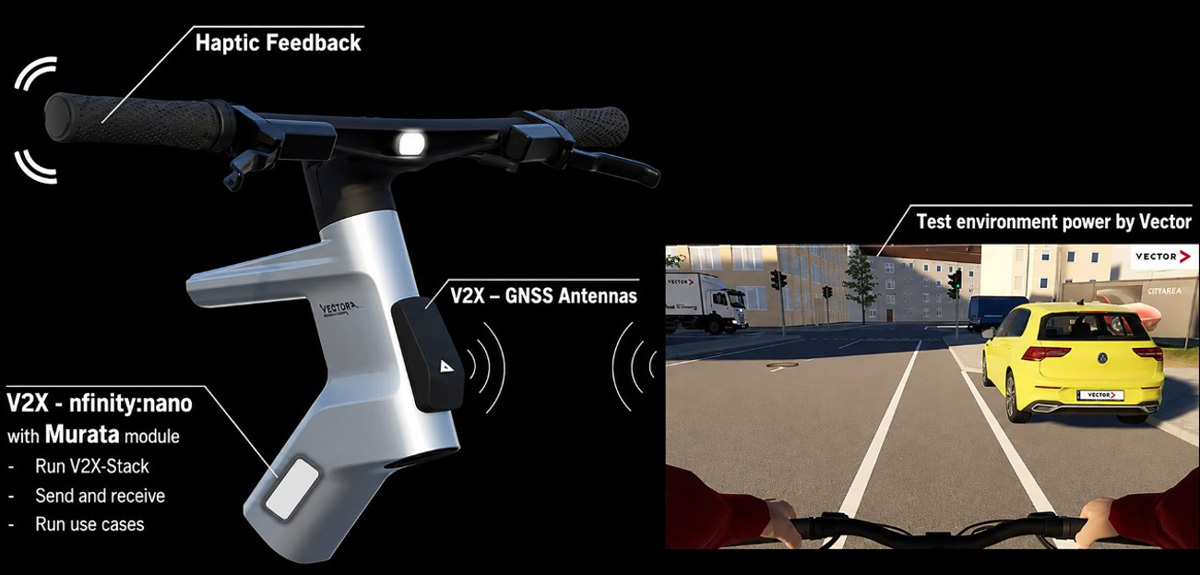
Vehicle-to-everything (V2X) communication allows road users and infrastructure to exchange information such as position, speed and direction in real time. Instead of relying only on sensors to detect what is visible, V2X allows nearby vehicles and infrastructure to receive information from road users that may still be hidden from view (Figure 1).
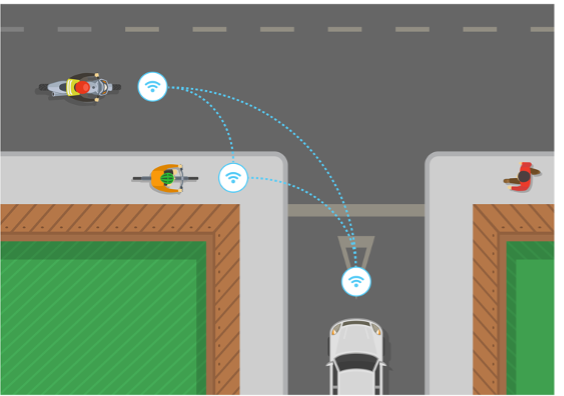
This capability can be seen in Canyon’s SafeRide V2X-enabled e-bike demonstrator. In the system, the bicycle exchanges standardised safety messages with nearby vehicles and infrastructure. As a cyclist approaches a blind junction, surrounding road users can be alerted to the bicycle before it enters their direct field of view.
The system translates connected-safety information into haptic feedback through the handlebars. Vibration in both grips indicates a general collision risk, while vibration in one grip indicates the direction of a potential hazard.
An e-bike imposes different design constraints
Bringing this capability to a bicycle creates a different engineering challenge from adding V2X to a vehicle.
An e-bike has limited space, limited power availability and little tolerance for additional hardware. Any communication system must be compact, power-efficient and reliable in a dynamic outdoor environment. It must also support safety-critical communication without making the bike harder to design, package or ride.
That is where the integration challenge becomes important. The value of V2X in micromobility depends not only on the communication standard, but on whether the technology can be implemented in a practical form factor for bicycles, e-bikes and scooters.
Building a V2X-enabled bicycle
In the Canyon SafeRide demonstrator, the connected-safety function is delivered through a collaboration between Canyon, Murata, nfiniity and Vector.
Murata’s V2X module provides the wireless communication capability. nfiniity’s cube platform provides the micromobility hardware and software foundation. Vector’s scenario-based V2X testing solution supports validation of real-world use cases. Canyon integrates the system into the bicycle in a way that preserves the rider experience (Figure 2).
Together, these elements allow the bicycle to become an active connected road user. Instead of relying solely on being detected by other vehicles, the bike can share its own position, speed and movement with the surrounding transport environment.
Bringing automotive-grade V2X to micromobility
Murata’s V2X module was developed to bring automotive-grade V2X communication into space-constrained platforms such as e-bikes.
Built around Autotalks’ chipsets, it supports both IEEE 802.11p-based DSRC and 3GPP Release 14, 15 and 16 C-V2X technologies on a single hardware platform. It also provides embedded security functions to help protect safety-critical communications.
For micromobility manufacturers, this reduces the amount of additional electronics required to implement connected-safety functions. More importantly, it provides a practical route to adding V2X capability to platforms where space, power and integration effort are tightly constrained.
Extending connected safety beyond the car
V2X was originally developed for automotive use cases, but the same principle is becoming increasingly important for micromobility. A connected safety network cannot protect vulnerable road users effectively if bicycles, e-bikes and scooters remain outside it.
Canyon’s SafeRide e-bike shows how that gap can be narrowed.