Engineering the Next Generation of E-Mobility and Vehicle Safety
The automotive industry is in a profound state of transformation. The electrification of vehicles and the push for improved vehicle safety are not separate trends; they are deeply interconnected. In addition to advancements in battery chemistries, OEMs are increasingly focusing on lightweighting to improve driving range and performance, which involves technological enhancements to the battery pack design, adopting new and innovative electrical/electronic (E/E) architectures, and more. Let’s take a look.
Advancements enabling significant optimisations in vehicle safety
The shift from traditional module-based battery packs to cell-to-pack (C2P) and cell-to-chassis (C2C) designs is a key innovation in the EV industry. These approaches not only reduce weight but also improve energy density, structural efficiency, and cost-effectiveness. As a result, they are playing a critical role in advancing the electrification of mobility.
The ever-increasing complexity of modern vehicles, particularly with the rise of electrification, Advanced Driver Assistance Systems (ADAS), and autonomous driving, has made traditional distributed (E/E) architectures inefficient and unsustainable. Instead of each function having its own dedicated electronic control unit (ECU), the industry trend is moving towards a hybrid approach where zonal-based architectures are combined with centralised computing. In this model, zonal controllers handle local processing and communication, and a central computer manages global decision-making and software updates.
The benefits of adopting a hybrid zonal architecture are two-fold. It significantly reduces the wiring complexity and the weight of the wiring harness. Secondly, localised processing reduces latency and improves the efficiency of critical real-time systems, namely ADAS and autonomous driving.
Additionally, traditionally mechanical systems, such as steering and braking, are being replaced with ‘by-wire’ systems (e.g., steer-by-wire and brake-by-wire), which are fully digitalised. These changes not only reduce vehicle weight but also enhance the precision and responsiveness of control systems, which are critical for ADAS and autonomous driving functionalities.
Furthermore, there is growing interest in 48V electrical systems, which provide a middle ground between traditional 12V systems and high-voltage EV architectures. These 48V systems are particularly attractive for mild hybrid vehicles and for powering advanced ADAS features, as they offer improved energy efficiency and support higher power loads without the complexity of full high-voltage systems.
These advancements are pivotal in addressing the challenges of electrification, ADAS, and autonomous driving. They collectively contribute to making vehicles lighter, more efficient, and better equipped for the future of mobility.
The role of regulations
Regulations play a crucial role in driving these safety improvements; for instance, the EU’s General Safety Regulation mandates features like Autonomous Emergency Braking (AEB) and Intelligent Speed Assistance (ISA). Similar regulations are emerging in the US, Japan, and China.
1. https://www.atic-ts.com/european-automotive-aebs-system/
The evolution of ADAS and autonomous driving systems follows the Society of Automotive Engineers (SAE) levels of automation. While many OEMs commonly offer Level 2 vehicles, further innovations continue to enhance vehicle safety and user satisfaction. Currently, only Mercedes and BMW offer Level 3 vehicles in Europe (mainly Germany), though only conditionally, as the system is always able to hand back control to the person behind the wheel.
Despite these developments towards higher automation, consumer surveys, such as one by S&P Global, indicate a greater preference for a broader range of ADAS functionalities over full self-driving autonomy, with sub-autonomous features like highway automated driving and remote parking being more desired.
Accurate positioning for enhanced safety
For the intelligent operation of vehicles, especially autonomous systems navigating urban routes, accurate perception is indispensable. Safe operation fundamentally relies on the ability to precisely perceive and interact with the surrounding environment. Advanced MEMS gyroscope and accelerometer devices have been instrumental in the success of autonomous vehicle operations, with Murata's previous-generation 6-degrees-of-freedom (6DoF) MEMS solution contributing to 90% of all autonomous vehicle miles driven in California.
Building upon this, the new Murata SCH1633-D01 sensor introduces improved performance, cost-effectiveness, and integration ease. Its SafeSPI 2.0 interface, featuring a 20-bit data frame, data ready timestamp index, and SYNC functions, allows accurate dead reckoning and seamless integration with various vehicle subsystems, including the global navigation satellite system (GNSS), chassis control, and vehicle attitude sensing for precise camera and headlight alignment.
Murata’s IMU also are well fitted to meet technical requirements such as the UNECE’s headlight regulations, which establish strict standards for vehicle lighting, particularly adaptive driving beam (ADB) systems. These systems automatically adjust the headlight beam to minimise glare for oncoming drivers while maintaining optimal visibility for the driver, simultaneously saving space and weight for vehicle manufacturers. Regulations such as these are designed to enhance road safety by reducing glare-related accidents and ensuring clear performance standards for
ADB technology, which itself demands high-performance position sensors for accurate headlight alignment.
Comprehensive perception within the vehicle cabin is equally critical for the effective activation of safety systems and for monitoring the state of passengers, particularly in scenarios where a driver may need to regain control. Radar modules, such as the Murata Type 1VM, employ
2. https://www.sae.org/news/blog/sae-levels-driving-automation-clarity-refinements
3. https://group.mercedes-benz.com/technology/autonomous-driving/driving/drive-pilot-95-kmh.html
4. https://www.press.bmwgroup.com/global/article/detail/T0443285EN/road-to-autonomous-driving:-bmw-is-the-first-car-manufacturer-to-receive-approval-for-the-combination-of-level-2-and-level-3?language=en
5. https://www.spglobal.com/automotive-insights/en/theme/automotive-consumer-trends
6. https://unece.org/fileadmin/DAM/trans/doc/2020/wp29gre/ECE-TRANS-WP29-GRE-2020-13e.pdf
Comprehensive perception within the vehicle cabin is equally critical for the effective activation of safety systems and for monitoring the state of passengers, particularly in scenarios where a driver may need to regain control. Radar modules, such as the Murata Type 1VM, employ continuously frequency-modulated signals to measure distance, angle, and velocity, thereby detecting movement inside the vehicle, including subtle motions caused by a passenger’s breathing. With an integrated CPU, this system processes data from multiple transmitters and receivers to detect occupants, discern whether they are adults or children, and identify their seating positions within the cabin.
Unlike in-cabin image sensors like cameras, which present privacy concerns, these radar modules enable OEMs to meet Euro NCAP Child Presence Detection scoring requirements . Suppose a child is detected within a locked vehicle. In that case, this system can facilitate the implementation of critical interventions such as sounding an alarm, lowering windows, or activating the air conditioning, thus helping to prevent unnecessary fatalities. This technology also extends to smart deployment of safety features like airbags and seat belt reminders, and can facilitate gesture control and passenger monitoring for autonomous taxi services.
Managing sensor fusion
While enhancing vehicle perception is essential for improving safety, it introduces significant engineering challenges, particularly concerning the integration of technology into the confined spaces of automotive designs. Miniaturisation of components is a key strategy to address this.
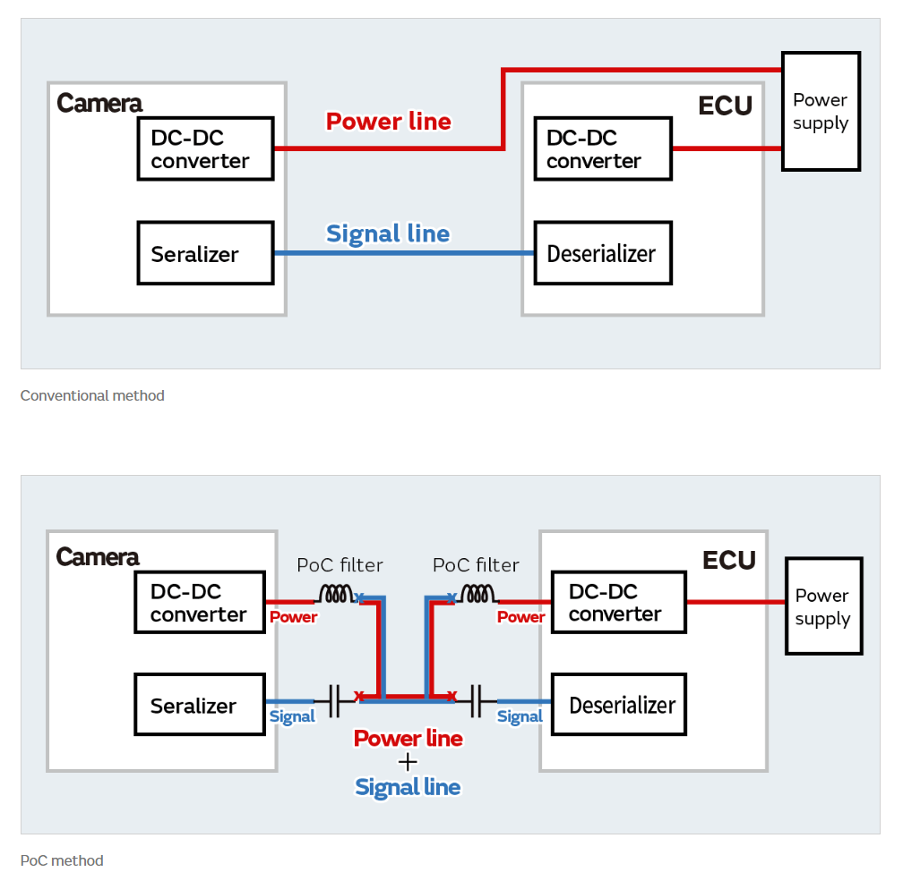
As vehicles incorporate more ADAS, the proliferation of image sensors significantly increases the amount of necessary cabling. To address this, many mobility manufacturers, including OEMs and Tier 1 suppliers, are adopting Power over Coaxial (PoC) technology. PoC effectively combines signal and power lines, substantially reducing the number of cables required for automotive cameras.
Implementing PoC necessitates the inclusion of a 'Bias-T circuit' at both transmitting and receiving ends, as well as within the power supply. The function of this circuit is to isolate the high-frequency signal from the DC power on the low-frequency side, utilising an inductor to filter video signals and a capacitor for the power supply.
7. https://www.euroncap.com/en/for-engineers/protocols/child-occupant-protection/
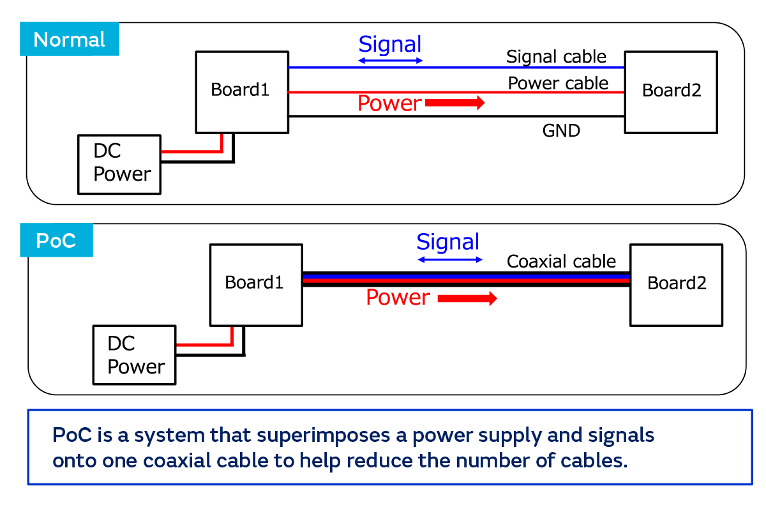
The process of selecting the correct combination of inductors for PoC can be complex. To address this complexity, Murata has developed the Bias-T Inductor Selection Tool (BIST), enabling designers to quickly identify suitable high-performance and compact inductors and ferrite beads, saving considerable time and effort without requiring specialised knowledge.
High-speed in-vehicle networks
Beyond sensor integration, reliable and efficient Ethernet-based zonal architectures are crucial for developing high-speed in-vehicle networks (IVNs). Murata offers a range of compact products providing excellent noise suppression, meeting the requirements for high-speed CAN/CAN-FD and vehicle-mounted Ethernet, alongside other network standards.
As pioneers in miniaturised common mode choke coils (CMCCs), Murata’s specific range for mobility includes components designed for CAN-FD signal lines (DLW32SH510XF2 or DLW32SH101XF2) and 1000Base-T1 Ethernet (DLW32MH101XT2), which are essential for supporting the infrastructure of next-generation vehicle safety systems.
Conclusion
As the industry continues to innovate, the convergence of electrification, safety, and connectivity will define the next generation of mobility. By addressing engineering challenges and leveraging cutting-edge technologies, automotive manufacturers are not only meeting regulatory demands but also paving the way for a safer, more efficient, and sustainable future of transportation, with partners like Murata providing the critical components that help make this vision possible.