The Engineering Behind Next-Generation Medical Wearables

Healthcare is shifting away from episodic treatment in hospitals toward continuous, data-driven care delivered wherever the patient is. Medical wearables are central to this transition, enabling real-time monitoring, earlier intervention, and more personalised treatment outside traditional clinical settings.
For chronic disease management, continuous monitoring fundamentally changes how care is delivered. Patients with diabetes, cardiovascular disease, or respiratory disorders can be monitored in real time rather than through intermittent clinical visits. This enables earlier detection of deterioration, more responsive treatment adjustments, and greater patient engagement in day-to-day health management.
Preventative care is another major application area. Continuous biometric monitoring allows clinicians to identify risk indicators before symptoms become severe enough to require intervention. By integrating with digital health platforms and telemedicine services, wearables facilitate seamless communication between patients and healthcare providers, supporting a more holistic and proactive approach to wellness.
However, delivering clinically reliable wearable technology presents significant engineering challenges.
Engineering for Continuous Wear
Devices such as ECG monitoring patches, continuous glucose monitors (CGMs), and blood oxygen and respiration monitoring patches are attached directly to the skin for extended periods, so movement introduces several engineering problems. The device can peel away from the skin, electrodes can shift position, motion can introduce electrical noise, and prolonged contact can irritate sensitive skin.
Environmental durability is another major requirement for wearable medical devices. Systems must operate reliably despite prolonged exposure to sweat, humidity, temperature variation, and contamination from daily wear. This demands robust materials engineering, corrosion-resistant interconnects, and stable encapsulation technologies capable of protecting sensitive electronics.
Flexible printed circuits (FPCs) offer some adaptability to body movement but remain limited under repeated bending and stretching. A key breakthrough is the advent of stretchable electronics, demonstrated by Murata’s Stretchable printed circuit (SPC), see Figure 1.
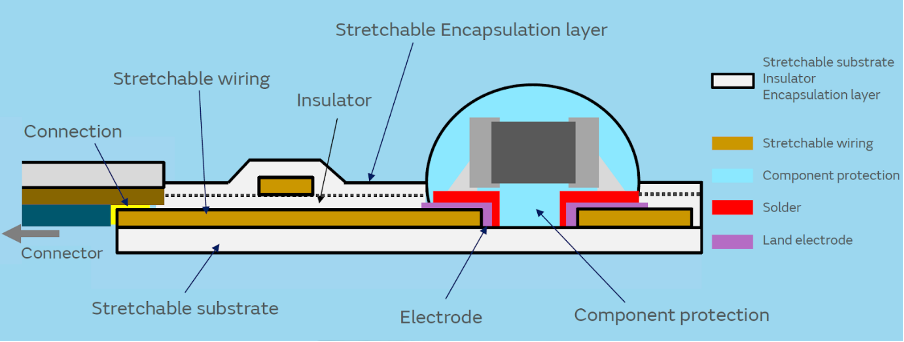
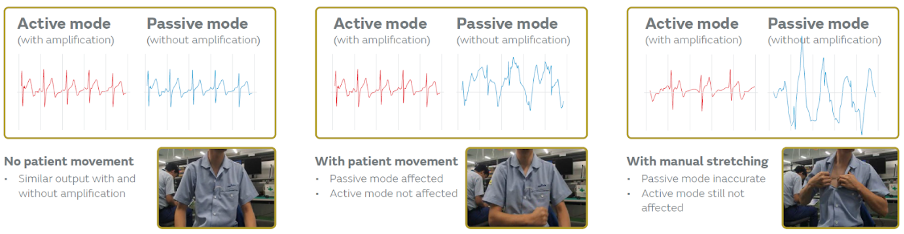
Unlike traditional FPCs, the ultra-thin, soft substrate, insulator and encapsulation layers and stretchable wiring allow sensors and electrodes to move naturally with the body, providing a second-skin experience. The close integration of amplifiers to the electrodes in the SPC enhances signal quality by reducing interference from patient movement, resulting in more accurate and reliable data capture, see Figure 2.
AI and Predictive Healthcare
Artificial intelligence (AI) is further increasing the value of wearable systems by enabling continuous physiological data analysis at scale. Machine learning algorithms can identify patterns associated with emerging health issues before symptoms become clinically apparent. In cardiovascular monitoring, for example, AI models can detect subtle irregularities that may indicate elevated risk of potential heat attacks.
This predictive capability allows healthcare providers to prioritise intervention for high-risk patients while reducing unnecessary clinical workload. For engineers, integrating AI into wearable systems introduces additional complexity. Devices must support secure data acquisition, edge processing, cloud connectivity, and reliable model deployment while maintaining low latency and high reliability.
The challenge is no longer simply collecting data. It is designing complete systems capable of converting continuous physiological signals into clinically meaningful insights. Murata’s approach combines robust hardware design with advanced cybersecurity features, ensuring data integrity and confidentiality throughout the device lifecycle.
The Road Ahead
Medical wearables are redefining how healthcare is delivered by extending monitoring beyond clinical settings and enabling more personalised, continuous care. As sensing technologies, materials science, AI, and system integration continue to advance, wearable platforms will support increasingly sophisticated applications across chronic disease management, preventive medicine, rehabilitation, and post-acute care.
Progress will depend on enhanced sensor accuracy and device miniaturisation, as well as solving broader engineering challenges involving comfort, durability, interoperability, scalable data analysis, and cybersecurity. Murata’s work in stretchable electronics demonstrates how advances in materials engineering and electronic integration can improve both usability and clinical reliability. By combining flexible system design with robust signal acquisition and secure data handling, wearable technologies can move closer to delivering truly continuous healthcare monitoring.