Select your region & language

LC Diplexers / LC TriplexersBasic knowledge about LC diplexers

What is a diplexer?

Devices used to electrically separate multiple frequencies in wireless systems with two or more different frequency bands are called multiplexers. They are also sometimes called antenna duplexers or splitters.
Diplexers are a type of multiplexer. They are devices used to electrically separate two different frequencies. This is made possible by sharing two filters with different frequency bands at one port (common port).
It is also possible to share three or more filters. Devices with three filters are called triplexers, those with four are called quadplexers, those with five are called pentaplexers, and those with six are called hexaplexers.

Diplexers Two filters with different frequency bands
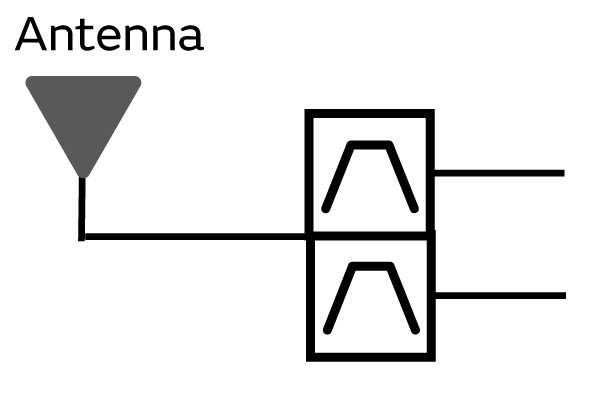
Triplexers Three filters with different frequency bands

Structure of diplexers

Diplexers have a structure in which a high-band filter and a low-band filter are connected via a phase shifter.
The point of connection with the phase shifter is called a common port. The impedance in the stopband becomes sufficiently high relative to the impedance in the passband by using a phase shifter.

How diplexers differ from duplexers

Duplexers are devices similar to diplexers. They are also called RF diplexers and RF duplexers in the field of wireless communication.
RF diplexers and RF duplexers are basically the same in that they are antenna duplexers and splitters. However, they are often used for different purposes as shown below.

RF diplexers

RF diplexers are used to separate and mix two relatively wide frequency bands whose frequencies are far apart to mix and separate signals using low-pass, high-pass or band-pass filters.

RF duplexers

RF duplexers are used when separating transmission and reception for FDD* applications. In other words, RF duplexers refer to devices that use cavity resonators with a high Q value to separate and mix frequencies that are very close for transmission and reception.

  • *Frequency Division Duplex (FDD): This is a communication method that assigns separate frequencies for transmission and reception.

What is an LC diplexer?

RF diplexers are sometimes referred to as LC diplexers.
Diplexers made using LC filters consisting of an inductor (L) and a capacitor (C) are called LC diplexers.

Murata's LC diplexers are diplexers with a multilayer structure made of low temperature co-fired ceramics (LTCCs), which have a low temperature coefficient, and copper-printed coils. In addition, they have low loss and outstanding electrical properties. That means they are used in cellular, Wi-Fi™, and various other applications.

We describe below the structure and types of LC filters and the details of LTCCs.

Types of LC diplexers

LC diplexers can be classified into three types based on the different methods they use to separate frequencies.

Low-pass/high-pass diplexers

This type of diplexer combines a low-pass filter connected to the low-frequency port and a high-pass filter connected to the high-frequency port.
It is the most common type of diplexer.

Low-pass/high-pass diplexers

Low-pass/band-pass diplexers

This type of diplexer combines a low-pass filter connected to the low-frequency port and a band-pass filter connected to the high-frequency port.
This configuration is common in diplexers for Wi-Fi applications.

Low-pass/band-pass diplexers

Band-pass/band-pass diplexers

This type of diplexer combines a band-pass filter connected to the low-frequency port and a band-pass filter connected to the high-frequency port.

Band-pass/band-pass diplexers

Examples of the use of LC diplexers

We introduce here examples of the use of Murata's LC diplexers.

Wi-Fi 6E/7

Wi-Fi is one of the wireless LAN standards. It indicates that interconnection between devices using the international IEEE 802.11 standard has been recognized.
Wi-Fi is used in a diverse range of devices including laptops, tablets, smartphones, and game consoles.
We give below examples of the practical use of LC diplexers for the Wi-Fi 6E/7 (2.4 to 2.5 GHz / 5 to 7.125 GHz frequency) standard.

Part numbers used: LFD182G45PJEF833 Examples 1 of the practical use of LC diplexers for the Wi-Fi 6E/7
Examples 2 of the practical use of LC diplexers for the Wi-Fi 6E/7
Examples 3 of the practical use of LC diplexers for the Wi-Fi 6E/7

We have an extensive lineup of products for non-cellular applications (Bluetooth®/Wi-Fi™/Sub-1 GHz).

Cellular

Demand for diplexers and triplexers for cellular applications is rising due to an increase in the number of channels and the introduction of CA*.
We have a lineup of products for each band and frequency. We give below examples of the practical use of LC diplexers that support the mainstream frequency separation methods of LB/MB, MB/HB and HB/UHB.

  • *Carrier Aggregation (CA): This is one method for speeding up wireless communication. It is a system of operating communications using multiple carriers in an integrated manner.
Part numbers used: LFD18788MPA4F498 (LB/MB)
This is a diplexer that separates the frequencies of 617 to 960 MHz / 1,427 to 2,690 MHz.
Examples 1 of the practical use of LC diplexers that support the mainstream frequency separation methods of LB/MB
Examples 2 of the practical use of LC diplexers that support the mainstream frequency separation methods of LB/MB
Part numbers used: LFD2H1G44MPEF859 (MB/HB)
This is a diplexer that separates the frequencies of 2,200 MHz / 2,300 MHz.
Examples1 of the practical use of LC diplexers that support the mainstream frequency separation methods of MB/HB
Examples2 of the practical use of LC diplexers that support the mainstream frequency separation methods of MB/HB
Part numbers used: LFD181G65PAGF743 (HB/UHB)
This is a diplexer that separates the frequencies of 617 to 2,690 MHz / 3,300 to 5,925 MHz.
Examples1 of the practical use of LC diplexers that support the mainstream frequency separation methods of HB/UHB
Examples2 of the practical use of LC diplexers that support the mainstream frequency separation methods of HB/UHB

We also have an extensive lineup of products for cellular applications including products that support 5G New Radio (NR).

Response to the need for downsizing

In recent years, the performance and size requirements sought in electronic components have been rising as smartphones and other mobile communication devices have been becoming more sophisticated and smaller. On the other hand, more filters are becoming necessary to support the ever-increasing frequency bands due to the shift to multi-band cellular communications and other factors.
Given this background, high-density mounting in a limited mounting space is becoming important. That means there is a growing need for the further downsizing of electronic components.

Murata has a lineup of small products at the 1005 size and LGA terminal diplexers to meet these downsizing needs.

Response to the need for components not affected by metal shields

The distance between electronic components and the metal shields inside devices has been shrinking due to the fact that mobile communication devices have been becoming smaller with a lower profile in recent years. As a result, these metal shields come into close proximity with the electronic components. This may cause interference and a deterioration in the characteristics of the electronic components.
In such situations, a drop in the terminal's communication speed and other defects may occur. Accordingly, there is a growing need for components not affected by metal shields.
Murata has incorporated new ideas into our LTCC technology to offer a lineup of shield robust products that minimize the effects of metal shields.
This minimizes the effects of the metal shields on the top surface and maintains stable characteristics for the electronic components even when the metal shields are in close proximity.

Side view
Simulation data for the characteristics at each distance between the product and metal shield
Part numbers used: LFD2H1G44MPEF859 (MB/HB)

Changes in characteristics due to the proximity of metal shields

As an example, we compare here the insertion loss in the high band because the metal shield tends to affect the high-frequency side more the closer it is in proximity to it.

*Comparison with the simulation data of the same 2,200/2,300 MHz (MB/HB) diplexer